Posted on

Hot Water Cylinder Trays Are Now Mandatory

IMPORTANT NOTICE: Safe trays are now compulsory with all new internal hot water cylinder installations, as per G12/AS1 clause 5.2.3 of the New Zealand building code.”

The above notice is what you will find on most newly sold (Image of a Rheem) hot water cylinders. Last year one of our blog posts discussed whether or not you need a cylinder tray. At the time the blog discussed a faulty product which resulted in flooding and insurance claim. In that particular instance the damage was minimal and covered by the manufacturer. Can you imagine the yearly claims when thousands of hot water cylinders are installed without hot water cylinder trays?important_notice

You can take a big guess on who would have lobbied the idea and pressed to get this incorporated into recent New Zealand building code G12 amendments. This standard sets a legal guideline on how a hot water cylinder may and may not be installed.

WHO BENEFITS?

Looking across the ditch, our Australian friends have had this requirement (regulation) as part of their compliance documents (e.g standard AS/NZS 3500) since 1996 but for some reason it never made it into the New Zealand building code, until now.

AS/NZS 3500 is also an acceptable standard in NZ which begs the question, why bother with two sets of standards in the first place?

Previously, accidental discharge control was optional unless a potential risk of water damage to another property existed, which in most cases only really applied to multi-story situations. Although control was considered “good practice” the homeowner could “opt out” to achieve savings on the installation. Or the plumber would keep it on the quite “to be competitive” and win a job against more expensive quotes that included the installation of a hot water cylinder tray.

Before the change, manufacturers such as Rheem have stated in installation instructions that a safe tray must be fitted, meaning plumbers should have already been recommending, quoting and installing hot water cylinder trays.

Now that this law has come into effect, ignorance is no longer bliss and benefits are relative to:

> The manufacturer knowing that installers can made responsible for water damage if the standard is not followed.

> The homeowner, knowing that any potential leaks are controlled while they are sleeping.

> The insurance, knowing they can legally peruse compensation on behalf of the homeowner.

Additional benefits also include:

  • Level playing field when plumbers are pricing jobs.
  • Prevention being the best protection.

NOTE: Plumbers and homeowners should ensure the installation complies with the updated standard to avoid any costs associated with non-compliance or resultant damage from water discharging from a hot water cylinder. 

SOME CHALLENGES AND CONSIDERATIONSunderbench_cylinder_on tray

Progress is always accompanied with challenges and challenges are accompanied with questions.

Some legalities are still undefined and It is not clear on whether a cylinder try must be installed on replacement hot water cylinders as well as newly installed hot water cylinders. When a “repair” or “like for like replacement” takes place, the building act allows one to maintain the current state of affairs. For example, although tempering valves are required by law, a plumber does not have to install a new one when replacing an existing old or damaged hot water cylinder that never had a tempering valve to begin with. Its good practice but not a legal requirement. He can just go ahead and maintain the existing setup treating the installation as a “like for like” situation.

But then this principal does not apply to seismic restrains. The DHB is yet to comment on this and we will update the blog once we know more.

Because compliance is relative and no job is like another, you want to be safe and ask the right questions before committing to any installation. Its always best to make an educated decision rather than deal with the unwanted consequences of ignorance.

ALTERNATIVES WHEN IT GETS TO EXPEN$IVE!rheem_27_instant_gas_water_heater

A cylinder tray needs to be connected to an approved point of discharge via a 32mm – 40mm drain. In many cases, for example double story homes the route of this drain becomes a major challenge. Especially when you are talking about cutting walls open or having surface mounted pipework to get the drain out.

If the cost or convenience of having a cylinder tray is not attractive, there are alternatives within the same ballpark in terms of $$$.


external_hot_water_cylinder

For example Instant water heating. For about the same price of new hot water cylinder + tray you can convert to gas and enjoy the many benefits. We offer LPG and natural gas solutions. Future-proof or expand, your possibilities are limitless.

Alternatively…

Relocate your hot water cylinder to the outside and free up that cupboard space. In external situations, no cylinder tray is required and the costs are about the same as a new internal hot water cylinder + tray.

Most of our customers tend to go for this option when the installation of a cylinder tray becomes too difficult or expensive. Talk to us for more information.

AMENDMENTS IN G12, 

Lets have a look at G12 a bit closer.

You can view the old and newer version (third edition) of G12 by following this link VIEW G12 AMENDMENTS.

Its very interesting to see that they have removed the wording from 6.11.3

a) Safe trays complying with Paragraph 5.2.3 where water could penetrate another household unit within the same building.

Which now reads:

6.11.3 Storage water heaters shall have: a) Safe trays complying with Paragraph 5.2.3

tray insallation

The above relevant paragraphs read as follows:

5.2.3 now reads..

Safe trays Performance E3.3.2: states that; Free water from accidental overflow from sanitary fixtures or sanitary appliances must be disposed of in a way that avoids loss of amenity or damage to household units or other property. An acceptable method of preventing water damage is to locate a safe tray below the water tank (see Figure 4). The safe tray shall incorporate a drain with a minimum diameter of 40 mm. Where the tank overflow discharges into the safe tray, the diameter of the safe tray drain shall be greater than the overflow pipe from the tank and comply with Paragraph 5.2.2.

RELATED PARAGRAPHS

5.2.2 Overflow pipes Water tanks shall have an overflow pipe to discharge any overflow to a visible place within the same property that does not create a nuisance or damage to building elements. The overflow pipe shall be sized so that the discharge capacity is no less than the maximum inlet flow. The outlet of the overflow pipe shall not permit the entry of birds or vermin. Overflow from a WC cistern may discharge internally into a WC pan.

COMMENT: Manufacturers’ literature must be referenced for pressure and flow information on tempering valves and tapware. Outlets (e.g. shower mixers and showerheads) must be appropriate for the available flow and pressure. Note the limitations on lengths and pipe sizes given

6.11 Water heater installation

6.11.1 Water heaters shall be installed in accordance with the manufacturer’s instructions.

6.11.2 Where heating units, sacrificial anodes, thermostats, pipework connections, valves, or other accessories being components of a storage water heater are installed, they shall be accessible for inspection, maintenance and removal.

6.11.3 Storage water heaters shall have: a) Safe trays complying with Paragraph 5.2.3 b) Connections compatible with the pipe material used, and c) Drain pipes (for every storage water heater of more than 45 litres capacity) which: i) have a conveniently located isolating valve, and terminate with a cap or plug suitably located to easily empty the vessel for maintenance, or ii) terminate outside the building with a cap only.
cyl;inder setup

The installation below shows the safety valves discharging into the cylinder plug and waste, which does not comply as one could argue that these pipes are blocking the passageway designed for the control of accidental water which is managed by the safe tray only. NZ Regulations define acceptable methods of discharge which includes safety valve drains.

cylinder_drains_into_tray


Posted on

What Is A Water Heater?

When selecting a new water heater for your home, choose a water heating system that will not only provide enough hot water but also that will do so energy efficiently, saving you money. This includes considering the different types of water heaters available and determining the right size and fuel source for your home.

Every home has a water heater and most of us are familiar with the big metal cylinders that can be found tucked away in our laundry room, basement or special “hot water cupboard”. Like all technology though, water heaters are constantly evolving with new design, new fuel systems and new sizing.

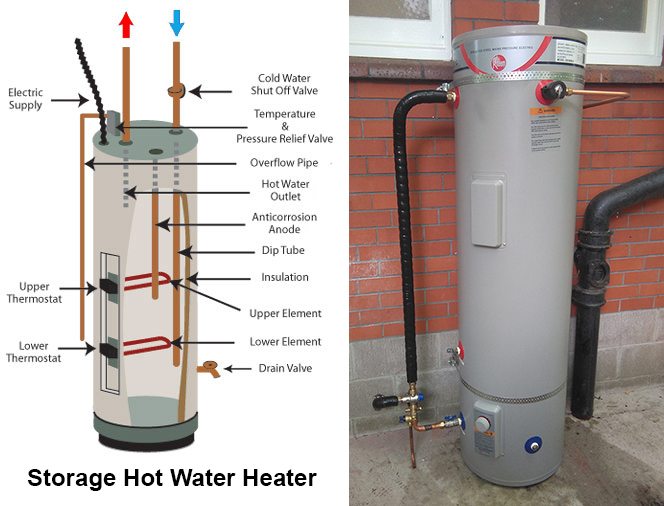
Storage Hot Water Heaters:

  • Inexpensive and widely available in a variety of sizes.
  • Waste 10%-15% of energy through radiant heat loss.
  • Can run out of hot water during extended use.
  • Life expectancy 10-15 years.
  • Average EF rating 0.67.
Storage_hot_water_heater

Tankless Hot Water Heaters:

  • Take up little space and can be mounted inside or on an outside wall.
  • Little or no standby energy loss.
  • Use 20% to 30% less energy than comparable storage tank models.
  • Hot water flow rate is limited by the size of the unit.
  • Can be expensive and costly to install.
  • Life expectancy 20 or more years
  • Average EF rating 0.75
tankless_water_heaters

Solar Hot Water Heaters:

  • Low to no energy cost.
  • Savings can pay for the unit in 8-12 years.
  • Requires the collector to be in full sun throughout the year.
  • Expensive and costly to install.
  • Usually use a conventional water heater for backup.
  • Life expectancy 20 or more years
solar_hot_water_heater

Heat Pump Hot Water Heaters:

  • Low operating costs.
  • Can only be installed in locations that stay between 4°-32° C.
  • Do not operate efficiently in a cold space.
  • Can install an air-source heat pump that combines heating, cooling, and water heating; or a standalone heat pump just for heating water.
  • Can be two to three times more energy efficient than electric water heaters.
  • Higher initial cost than storage water heaters.
  • Colder climates using a heat pump water heater may add to heating and cooling loads.
heat_pump_hot_water_heaters

The newer styles have generally lost the big bulky tank completely in favour of hot water-on-demand. What makes a water heater (no matter which type you have) interesting is that they exploit the heat rising principle to deliver hot water right to your tap with a minimum of fuss.
To create hot water, a scientific process called thermodynamics is required. This process uses an energy source to heat water above the initial temperature it arrives into your home at. In a typical home, we use hot water in cooking, cleaning, bathing, and space heating.
There are various types of water heaters available and the type you choose will inherently depend on where you are based, how many people are going to be using hot water and the kind of energy sources you’ll be using (electric, gas, solar or wood).

Your water heater is a cleverly designed system that heats cold water to an ambient temperature. They are generally reliable and can operate for years without any issues. When water comes into your home, depending on the time of the year, it makes a journey through a system of pipes, and it’s usually cold or cool. If you are not a fan of bathing in cold water or washing your dishes or clothes in cold water, then you need a water heater.

When choosing a water heater, you should keep an eye out for a technical term – “recovery rate”. The Recovery Rate is the speed at which a water heater heats your water to 37.7C in an hour. Once you draw water faster than it’s heated, the temperature drops. Choosing a water heater that has an appropriate capacity and recovery rate depends on how much water your home demands and how your unit heats the water. Typically, heaters with low recovery rates have a high tank capacity. Although it takes longer to heat the water, there’s more of it for intermittent use. Electric heaters fall into this category. On the other hand, a fuel-fired heater (gas or oil) with a high recovery rate needn’t have a large tank, because it can heat the water faster. In general, electric models have the lowest recovery rate, and oil-fired units have the highest.
If you’re considering replacing or simply installing a new water heater, looking at the various advantages and disadvantages is always wise. Some of the general pros and cons we can share with you are:

We know that purchasing a water heater requires a lot of thought. Call us on 0800 429 546 today and we can help you select the best water heater for your needs.

Posted on

Explaining electric hot water heaters

What is an electric hot water heater?

How do electric hot water heaters work?

What are the differences between hot water heaters available?

Most of us don’t give a passing thought to how our water is heated as long as it is hot when we turn on the hot water tap or get in the shower. There are various ways our water can be heated and these generally are by Gas, Heat Pump, Solar, Wetback or Power (Electricity).

An electric powered water heater can be referred to by many names – a hot water storage tank, a hot water tank, thermal storage tank, hot water thermal storage unit, heat storage tank or a hot water cylinder.

storage_hot_water_heater

Electric hot water cylinders are the most common form of water heating in New Zealand.

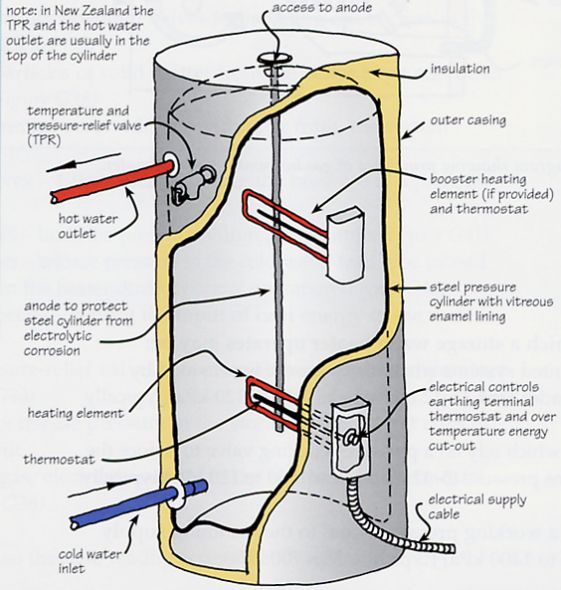
The cylinders use an electric element in an insulated tank to heat the water to a temperature set by a thermostat.

It acts a bit like a hot water jug or kettle. It has an immersion element inside the cylinder (which looks like a metal loop or coil) and it heats the surrounding water.

The cylinder is an insulated water tank with a cold tube to carry water in, and a hot tube to send the water where it’s needed inside the home. The heating is controlled by a thermostat that turns on the heating element when the water goes beneath the pre-set temperature.

When the heating element is on, electric power runs through it, creating heat. Unlike a gas water heater, the heat does not go through a heat exchanger. Instead, it flows directly into the tank’s water supply.

Electric water heaters (with an immersion element) are more energy efficient than gas water heaters. A conventional electric model averages a 90 percent efficiency rating, while a conventional gas water heater averages a 60 percent rating. Electric power is generally more expensive than natural gas.

Gas does outperform the electric model in water heating speed and recovery time. A gas heater can heat around 190 litres in roughly an hour, while an electric heater takes several hours to heat the same volume.

Some other benefits to electric hot water heaters are that out of all the various types of water heating products available, they have the lowest upfront cost.

They also have a certain amount of flexibility. You can buy cylinders with additional connections suitable for having a solar water heater, heat pump water heater or wetback added in the future. This allows you to change the way you use your hot water, and for adaptation should your family size grow or the demands you require on hot water change.

You can purchase an electric hot water heater that has a thermostatic control. This means that it will automatically turn off when it reaches the temperature you set on the thermostat. This will save you money over time.

If you have a boiler system in your home, an electric water heater will not be connected to your boiler. This means that if your boiler breaks down, you can still generate hot water for your home.

If you well insulate your electric water heater, it can keep water hot for several hours after it switches off. You can set a timer on your heater so that it only switches on during cheaper off-peak electricity hours.

You can usually turn your electric water heater on or off by simply flicking the switch on the wall socket. This is a great power savings ability especially useful if you are going away on holiday and you will have no need for hot water in the house while you are away.

And what kind of things should you be aware of regarding an electric hot water heater?

  • Heating water using electricity is more expensive than heating water with say, gas. A typical electric water heater uses 3 kilowatts of electricity an hour, so it will cost the average house about 78c an hour to run. Most households will need to run an electric water heater for at least a couple of hours a day to get the water hot enough – costing at least $560 a year.
  • An electric water heater needs a thermostatic control, otherwise it can heat the water to far too high a temperature.
  • Some heating engineers may recommend you leave your electric water heater on 24/7 – however, this can be very expensive unless it has a thermostatic control.
  • Be aware that you need to heat the water in your electric water heater to above 50°C to kill off bacteria.Above all consider all of your options. What works for one household might not be the best option for yours. Getting the sizing, the placement and the installation right is important for obtaining your long term enjoyment from your new water heater.