Posted on

Why Hot Water Cylinder Failures Are Increasing

In an article published on Christchurch City Council, there are rising incidents of hot water cylinder failures. The report says that Christchurch’s water supply has been temporarily chlorinated, which led to the failures.

The Christchurch City Council is looking into this problem and they have determined the reasons for the breakdown of hot water cylinders.

Hot Water Cylinders Failing

Historically, Christchurch has been dealing with issues concerning hot water cylinder failure. Some parts of the city, such as Cashmere, have been affected more than others.

Authorities from the Christchurch City Council are hard at work trying to determine the scale and potential causes for the increase in hot water cylinder failures in the past several months.

wet_patch_under_cylinder

Potential Causes for the Failures

Multiple factors may cause hot water cylinder leaking, which then requires for it to be replaced. These include: the type of cylinder, the age of the cylinder, the chemical composition of the water, whether or not there is debris in the cylinder, and the quality and thickness of the copper used in the hot water cylinder,

The City Council has been working closely with manufacturers. They have now uncovered that majority of the hot water cylinders that are breaking down are those older, low pressure, copper cylinders.

How Water Chlorination Affects Hot Water Cylinders

Some parts of New Zealand that have chlorinated water are not experiencing significant numbers of hot water cylinder failures. The reason for this is the chemical composition of water supplies around the country varies from place to place.

Auckland and Wellington use surface water or water from rivers and streams. This creates a protective film when it comes into contact with copper plumbing. Christchurch uses groundwater from aquifers.

Meanwhile, pitting corrosion that leads to pinhole failure usually happens in some bore water or underground supplies.

Hastings and Napier, for example, have bore water supplies. They have also experienced an increase in hot water cylinder failures following the chlorination of their water networks. In the Napier and Hastings area, the number of failing cylinders has decreased over the year after water chlorination was done.

Here’s What the Christchurch City Council Says

The Christchurch City Council has given this advice to people who needed to repair or replace their hot water cylinder:

“We understand that having to replace your hot water cylinder is a costly exercise and we also acknowledge that there has been an increase of hot water cylinders failing since the introduction of chlorine.

“It’s important to remember there are multiple factors as to why pitting occurs in hot water cylinders. These include: chemical makeup of the water, age of the cylinder, type of cylinder used, debris in the cylinder, and the quality and thickness of copper used. Because of this, the Council is not compensating property owners.

“We are continuing to monitor the situation and work with manufacturers and suppliers to gain further understanding. Work is also progressing on our well head remediation programme to reduce the chlorine levels in our water.”

Do You Need to Replace Your Hot Water Cylinder?

Certain cylinders are sold in areas where pitting corrosion is prevalent. If you need to replace your hot water cylinder, contact Hot Water Cylinders NZ to get the best choices for your area. Options may include stainless steel or enamel-lined steel cylinders.

Does Chlorine Affect Gas Systems or Pipes?

This is one of the more common questions that residents ask. Does the chlorine that is reacting with copper in hot water cylinders also impact gas systems or pipes?

So far, there has been no increased number of failures in copper heat exchangers in copper water pipes, gas continuous flow units, or other fittings.

Conclusion

The Christchurch City Council states, “We agree that the presence of chlorine in the water, along with the other factors, such as temperature, details of installation, and water chemistry, has contributed to the observed pitting corrosion. We similarly agree that pitting corrosion of hot water cylinders is likely to become more frequently observed.  Whether or not this extends to other copper plumbing fittings is yet to be determined.”

Posted on

New Zealand’s first Hot Water Cylinder Size Finder

Will your new hot water cylinder fit in the same space as your old one?

Which hot water cylinder will fit? Find hot water cylinders by size.
Hot Water Cylinders LTD makes it possible!

CLICK HERE TO USE OUR HOT WATER CYLINDER SIZE FINDER

find_cylinder_size

Our new hot water cylinder finder is a search engine that will find any cylinder available in New Zealand that will fit within your given parameters.  Enter the available space you have in terms of height and width (diameter), then submit.

The result will deliver which cylinder will either exactly fit or is just over your given parameters.

_hot_water_search_engine

For your convenience you can also filter by brand, pressure type and price. We are confident that this tool will help you find the right product quickly. Enjoy!

Once you have found your product, why not get an installation price? Free and best price quotes are available around the clock. Call us on 0800 429 546 for more information or use our hot water cylinder price calculator.

Posted on

Explaining electric hot water heaters

What is an electric hot water heater?

How do electric hot water heaters work?

What are the differences between hot water heaters available?

Most of us don’t give a passing thought to how our water is heated as long as it is hot when we turn on the hot water tap or get in the shower. There are various ways our water can be heated and these generally are by Gas, Heat Pump, Solar, Wetback or Power (Electricity).

An electric powered water heater can be referred to by many names – a hot water storage tank, a hot water tank, thermal storage tank, hot water thermal storage unit, heat storage tank or a hot water cylinder.

storage_hot_water_heater

Electric hot water cylinders are the most common form of water heating in New Zealand.

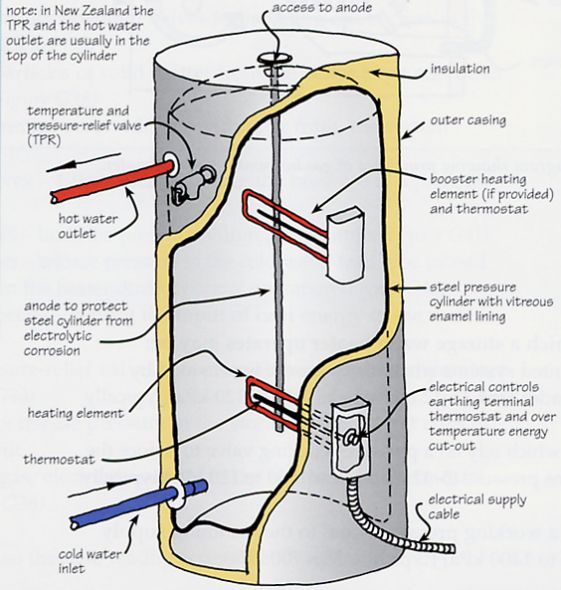
The cylinders use an electric element in an insulated tank to heat the water to a temperature set by a thermostat.

It acts a bit like a hot water jug or kettle. It has an immersion element inside the cylinder (which looks like a metal loop or coil) and it heats the surrounding water.

The cylinder is an insulated water tank with a cold tube to carry water in, and a hot tube to send the water where it’s needed inside the home. The heating is controlled by a thermostat that turns on the heating element when the water goes beneath the pre-set temperature.

When the heating element is on, electric power runs through it, creating heat. Unlike a gas water heater, the heat does not go through a heat exchanger. Instead, it flows directly into the tank’s water supply.

Electric water heaters (with an immersion element) are more energy efficient than gas water heaters. A conventional electric model averages a 90 percent efficiency rating, while a conventional gas water heater averages a 60 percent rating. Electric power is generally more expensive than natural gas.

Gas does outperform the electric model in water heating speed and recovery time. A gas heater can heat around 190 litres in roughly an hour, while an electric heater takes several hours to heat the same volume.

Some other benefits to electric hot water heaters are that out of all the various types of water heating products available, they have the lowest upfront cost.

They also have a certain amount of flexibility. You can buy cylinders with additional connections suitable for having a solar water heater, heat pump water heater or wetback added in the future. This allows you to change the way you use your hot water, and for adaptation should your family size grow or the demands you require on hot water change.

You can purchase an electric hot water heater that has a thermostatic control. This means that it will automatically turn off when it reaches the temperature you set on the thermostat. This will save you money over time.

If you have a boiler system in your home, an electric water heater will not be connected to your boiler. This means that if your boiler breaks down, you can still generate hot water for your home.

If you well insulate your electric water heater, it can keep water hot for several hours after it switches off. You can set a timer on your heater so that it only switches on during cheaper off-peak electricity hours.

You can usually turn your electric water heater on or off by simply flicking the switch on the wall socket. This is a great power savings ability especially useful if you are going away on holiday and you will have no need for hot water in the house while you are away.

And what kind of things should you be aware of regarding an electric hot water heater?

  • Heating water using electricity is more expensive than heating water with say, gas. A typical electric water heater uses 3 kilowatts of electricity an hour, so it will cost the average house about 78c an hour to run. Most households will need to run an electric water heater for at least a couple of hours a day to get the water hot enough – costing at least $560 a year.
  • An electric water heater needs a thermostatic control, otherwise it can heat the water to far too high a temperature.
  • Some heating engineers may recommend you leave your electric water heater on 24/7 – however, this can be very expensive unless it has a thermostatic control.
  • Be aware that you need to heat the water in your electric water heater to above 50°C to kill off bacteria.Above all consider all of your options. What works for one household might not be the best option for yours. Getting the sizing, the placement and the installation right is important for obtaining your long term enjoyment from your new water heater.